Product integration of two Identity and Access Management UIs

Category: Software • Time: 1,5 Years • 2023-2025

In this role I designed solutions that simplify how organizations manage identities and access. This case study focusses on the project of integrating two UIs after a company merger.

Due to confidentiality agreements, I’m unable to showcase details (artefacts are anonymized) but am happy to discuss them in a personal conversation.

UX REsearch

CONCEPT

UI DeSIGN

AI ENhanced WorkFLOWS
Results

Problem Statement & Goals

A unified concept, documented through use cases and high fidelity mockups, that development built in about 18 months.

Problem Statement

Problem Statement & Goals

Following a merger, both companies operated products with overlapping functionality, one product focussing on Identity Lifecycle Management and permissions and one on permissions for SAP Roles IGA.

Opportunity

Problem Statement & Goals

Consolidate the two products into a single UI covering the combined functionality, without inheriting either legacy system’s technical or usability debt.

Role in Project

Role in Project

Hired specifically for this project as the first designer in the company. Sole UX designer for the majority of the project lifecycle. Later responsible for one work stream, collaborated with designers on the design system while continuing to lead the project.

Collaborating with Head of Development (Company A acting as PM), Head of Product Management (Company B), software architect and three Development Teams

Users

Admins and IT staff managing identities and access within a company as well as team managers requesting access for their team members.

Design Process

Research & planning of the new UI:

Started to work on the main use cases “Create, View, Edit, Delete Identities and Accounts” right away. The next use cases followed these steps:

  • Addressed the lack of existing design artefacts and documentation in a first step to understand the complex functionality of products and users

    • Conducted internal interviews, collecting customer feedback available, creation of persona

    • Created of User Flow Diagrams to have an overview of existing functionality

Creation of Persona for both products

Creation of User Flow diagrams for all functionality

Further steps:

  • Collected and compared User Stories in workshops and assessed overlapping use cases

    • Use cases that were existing in both products were flagged, even if the concepts were varying and the user data handled differently

    • Differences were explained and compared in a table

  • Discussed technical requirements with the software architect and development team lead

  • Collected competitor product information in a report

    Presentation of the results to and discussion with Head of Product Development (PM) and Head of Product Management. On this basis, these two stakeholders defined the MVP functionality. The decision was made to focus on the administrative view first.

    The project followed an agile process, working through the defined use cases in iterative cycles.
    The use of AI was introduced into the project gradually (starting 2023). I used it to save time in creating project and design documentation, writing UX copy, and working through edge cases while reviewing all output and adapting it to fit the project.

Assessment of overlapping user stories in a workshop

Presentation of the results to and discussion with Head of Product Development (PM) and Head of Product Management. On this basis, these two stakeholders defined the MVP functionality. The decision was made to focus on the administrative view first.

The project followed an agile process, working through the defined use cases in iterative cycles.

Concept:

  • Sketching, creation of first wireframes and iterating with the Head of Product Development (PM)

  • Continuously checking technical restrictions with the software architect to make sure the user actions match the requirements for data processed in the back and synchronization with systems and directories

  • Iterations on concept and feedback cycle

UI Design

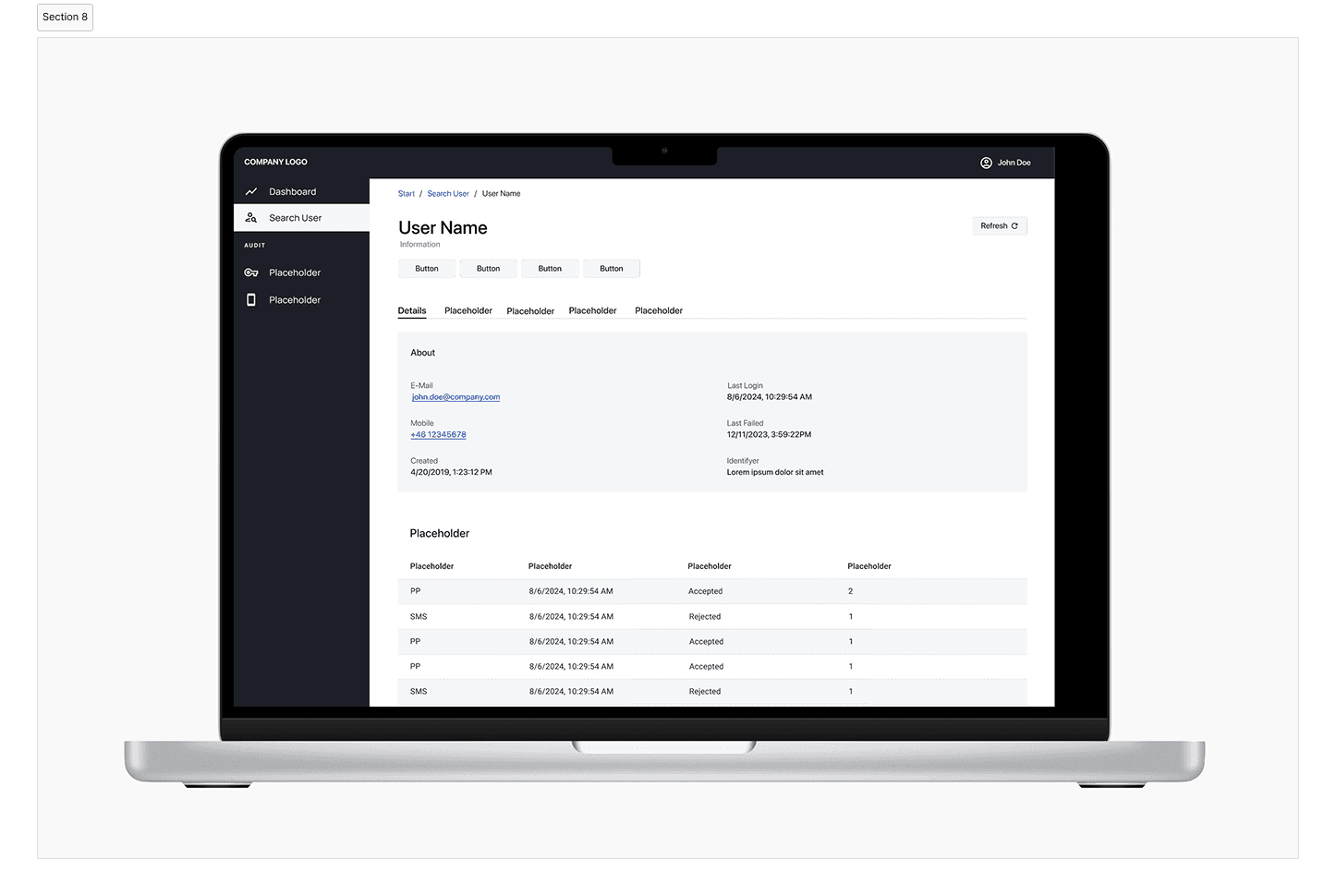
  • Creating high fidelity design mockups using Figma using the company design system

  • Communicating the planned functionality to Software Architect, Team Leads, 3 development teams who were already working on the backend implementation

  • Creation of the initial design system was done by the Design Lead. Involved from the planning stage, I defined the component needs for the products I was responsible for. Adding further components after review with the Design Lead

Handover

  • Use case description and finished mockups were presented to and handed over to the development teams

  • Lead recurring design QA sessions to confirm the implementation matched the design intent

Mock up example of Systems and accounts

Conclusion

Role in Project

Created a unified UI concept and design that development built out over about 18 months.


The biggest challenge in this project was to keep everyone informed since there were a large number of stakeholders involved: Head of Development acting as PM, a Head of Product Management, a software architect, three team leads and their development teams as well as a technical writer. An additional cross-company meeting was created to keep everyone on the same page.

As the company's first designer, I spent much of my time explaining UX design for example: why use cases were documented or what design QA is needed for. Once the teams understood the process the reviews got faster and questions about design and concept came earlier in the process.

Location

Munich, Germany

open to relocating